Contact Shock Freezer: The Complete Guide for Blood Banks, Hospitals & Plasma Processing Facilities
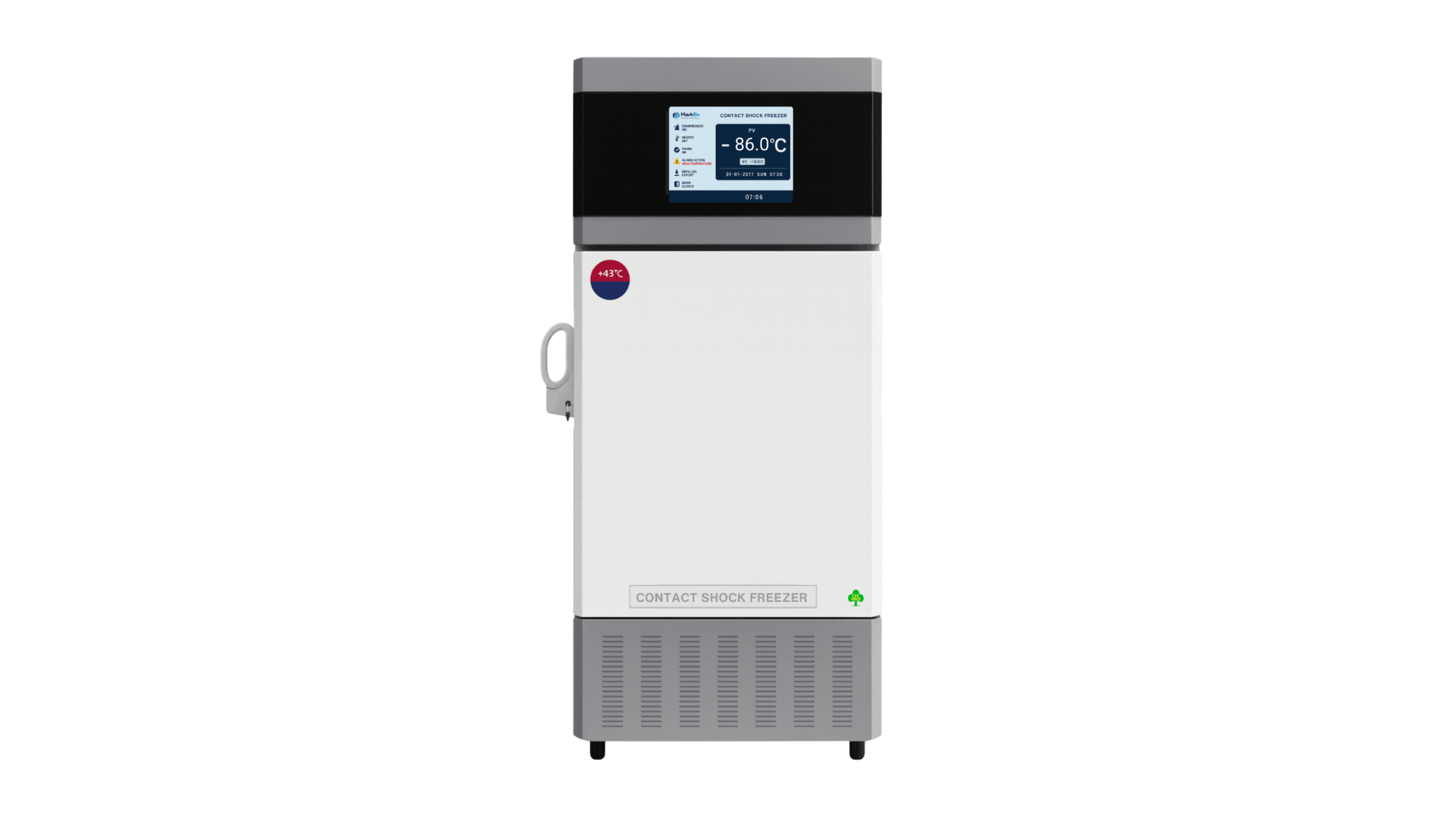
A contact shock freezer is one of the most important investments a blood bank or transfusion centre can make. The quality of fresh frozen plasma (FFP) and cryoprecipitate depends directly on how fast and uniformly plasma bags are frozen after collection. The faster the freeze, the better the preservation of critical coagulation factors — and the better the clinical outcome for patients receiving these life-saving blood products.
The MarkEn Contact Shock Freezer is engineered precisely for this purpose: rapid, uniform, and compliant plasma freezing for blood banks, hospitals, transfusion centres, and plasma processing facilities where speed, sterility, and regulatory alignment are non-negotiable.
What Is a Contact Shock Freezer?
A contact shock freezer is a specialised medical refrigeration device that freezes blood plasma bags by applying refrigerated contact plates directly to both sides of each bag simultaneously. Unlike conventional air-phase blast freezers that use cold air circulation to freeze plasma, a contact shock freezer transfers cold energy directly through physical contact, achieving dramatically faster and more uniform freezing across every bag in the load.
This direct-contact methodology ensures homogeneous freezing even when bags have air bubbles or uneven filling, producing a consistently flat, uniformly frozen product that is easier to store and process downstream. The MarkEn Contact Shock Freezer delivers this precision in every cycle, making it the benchmark device for modern plasma component manufacturing. Also read about: Sterile Connecting device
Contact Shock Freezer for Blood Bank: Why Speed Matters?
Using a contact shock freezer for blood bank operations is not just about convenience - it is a quality and compliance imperative. Fresh frozen plasma must be frozen within 8 hours of collection to qualify as FFP and retain maximum coagulation factor activity. Any delay or slow freezing degrades these factors irreversibly.
A contact shock freezer for blood bank use delivers several critical operational advantages. It achieves target core temperatures of below minus 30 degrees Celsius in under 30 minutes for standard plasma bags. It maximises yields of cryoprecipitate by ensuring rapid temperature pulldown. It eliminates the production bottleneck that occurs when large volumes of donor blood arrive at end of day. It ensures uniform freezing across all bags in a single load regardless of fill volume variation. And it supports full batch traceability with integrated monitoring for regulatory documentation.
For blood banks processing hundreds of units daily, a validated contact shock freezer for blood bank workflow is the single most impactful upgrade available in plasma component manufacturing.
Contact Shock Freezer vs Blast Freezer: Key Differences
Understanding the difference between a contact shock freezer vs blast freezer helps facilities make the right procurement decision. Both devices are designed for rapid plasma freezing but their mechanisms, performance, and outcomes differ significantly.
A blast freezer circulates high volumes of very cold air around plasma bags to achieve rapid cooling. While faster than standard storage freezers, air-phase cooling is inherently less efficient because air is a poor conductor of thermal energy compared to direct solid contact. This results in longer freeze times, less uniform freezing across individual bags, and a higher risk of irregular bag shapes after freezing.
A contact shock freezer vs blast freezer comparison consistently shows that contact-based devices achieve faster, more uniform freezing with better coagulation factor recovery, more consistent bag geometry for downstream storage, and superior repeatability from one load cycle to the next without operator-dependent variability. The MarkEn Contact Shock Freezer uses precision-engineered refrigerated contact plates inclined at a slight angle to ensure complete contact with every bag surface, delivering results that air-phase blast freezing simply cannot match.
Plasma Contact Shock Freezer: How the MarkEn Device Works
The MarkEn plasma contact shock freezer uses a dual-plate contact mechanism where plasma bags are loaded between two refrigerated plates. Linear actuators self-adjust to apply the correct pressure against each bag regardless of fill level, ensuring consistent plate-to-bag contact across the entire surface area. The plates are inclined at a slight angle to maximise contact uniformity and eliminate air pockets. The device operates with two independent levels, allowing simultaneous freezing on one level and defrosting on the other, enabling continuous throughput without downtime between batches.
The MarkEn plasma contact shock freezer achieves core temperatures below minus 30 degrees Celsius rapidly, preserving the maximum possible activity of coagulation factors including Factor VIII and fibrinogen — the components most critical to cryoprecipitate yield and clinical utility.
Fresh Frozen Plasma Freezer Compliance and Regulatory Standards
Every fresh frozen plasma freezer used in a licensed blood bank must comply with applicable regulatory standards. For Indian blood banks, this includes compliance with the Drugs and Cosmetics Act and Schedule F Part XII B, NABH blood bank accreditation standards, WHO GMP guidelines for blood establishments, and AABB standards for facilities seeking international accreditation.
The MarkEn fresh frozen plasma freezer is designed with full regulatory traceability built in, supporting temperature logging, alarm documentation, batch-level records, and integration with facility quality management systems. This makes compliance audits and accreditation processes significantly more streamlined for blood bank administrators.
Plasma Freezer for Blood Bank: Applications Beyond Fresh Frozen Plasma
While FFP freezing is the primary application, a plasma freezer for blood bank operations serves a broader range of critical functions. These include preparation of cryoprecipitated AHF from fresh frozen plasma, freezing of solvent detergent treated plasma, processing of apheresis plasma collected from single donors, preparation of pathogen-reduced plasma components, and storage of rare blood group plasma inventories for emergency use.
The MarkEn plasma freezer for blood bank is built to serve all these applications with equal precision, making it a versatile and high-value addition to any blood bank or transfusion centre workflow.
Blood Plasma Freezer for Hospitals and Transfusion Centres
Hospitals with in-house transfusion services require a reliable blood plasma freezer that can handle the demands of both routine component preparation and emergency surge volumes. The MarkEn blood plasma freezer is compact enough for benchtop or dedicated workstation installation in hospital transfusion laboratories while delivering the throughput and performance of larger institutional systems.
For transfusion centres managing high daily volumes, the device's independent dual-level operation means one level can begin a new freezing cycle while the previous load defrosts on the second level — maximising throughput and eliminating idle time between batches.
Frequently Asked Questions
Recent blog
View All- The Hidden Cost of Downtime: Why Reliable Cold Storage Is a Strategic Investment for Healthcare Facilities
- What Happens Between Manufacturing and Patient? The Journey of Temperature-Sensitive Medicines Through the Cold Chain
- How Alarm Systems Improve Cold Chain Reliability
- Blood Donor Couch: The Complete Guide for Blood Banks, Hospitals and Donation Centres
- Plasma Thawing Bath: The Complete Guide for Blood Banks, Hospitals and Laboratories
- Sterile Connecting Device: The Complete Guide for Blood Banks & Healthcare Facilities
- Cytocentrifuge: Uses, Principle, Parts & Preparation
- Solar Direct Drive Systems: The Future of Battery-Free Vaccine Refrigeration
- Insulated Vaccine Van: Complete Guide to Vaccine Transportation and Cold Chain Logistics
- Blood Bag Tube Sealer: Essential Equipment for Safe Blood Storage and Handling